The Occupational Profile of the Village of Torphichen.
This paper examines the changing occupational profile of Torphichen, West Lothian over a period 1841 -1891 and the effects of those occupational changes. The census Enumerator’s Books are the main source. Pre 1840 agricultural occupations and associated trades prevailed along with coal mining and limestone quarrying. Later, industrial work, in the form of a paper mill, became available in the neighbourhood village. This, and the decline of mining had an effect on both the composition of the workforce and the socio-economic structure of the village. Research drawn upon includes that of Donnachie and MacLeod (1974) McKay (1975) and Treble (1990)
Linlithgow in Early Modern Times.
UNDER CONSTRUCTION.
Medieval Architecture and Rural Society in West Lothian.
The purpose of this current research exercise is to bring together and to analyse the documentary and physical evidence for medieval and sub-medieval settlement in the former county of West Lothian.
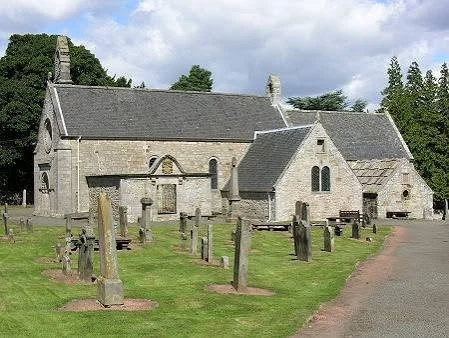
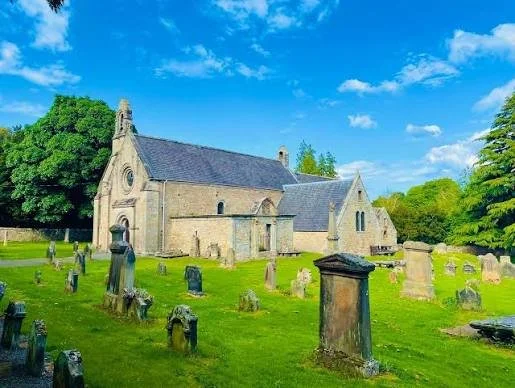
Abercorn Kirk, West Lothian.
Abercorn Kirk, West Lothian by Frank Reynolds
Abercorn Kirk is a small building with an unusually large story. Set in the village of Abercorn, on the Hopetoun Estate, it stands in a quiet and beautiful place, but its history reaches back to the earliest centuries of Christianity in Scotland.
There has been a Christian presence at Abercorn for around 1,400 years. The site is mentioned by the Venerable Bede in his Ecclesiastical History of the English People, where he refers to the monastery at Abercorn. The church is reported to have been dedicated to St Serf, one of the early saints associated with eastern Scotland.
In 681, Trumwine was appointed Bishop of the Picts, with Abercorn as his seat. At that time, the Northumbrian church had influence north of the Forth. This did not last long. After the Northumbrians were defeated by the Picts at the Battle of Nechtansmere in 685, Trumwine probably left Abercorn in great haste. He later retired to Whitby. Even so, his short-lived bishopric gave Abercorn a special place in Scottish church history.
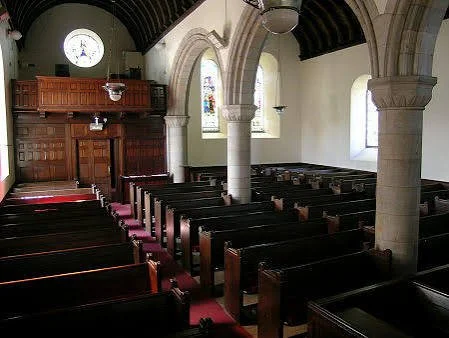
In the Middle Ages, Abercorn became part of the Diocese of Dunkeld. This may seem unusual, as it lies south of the Forth, but medieval church boundaries often followed old landholdings and earlier church connections rather than simple geography. The present kirk still carries traces of that long history, including early carved stones and surviving medieval work. Like many old Scottish churches, it has been altered over the centuries, especially after the Reformation, but its ancient roots can still be felt.
The kirk is also closely linked with two important local families: the Dalyells of the Binns and the Hopes of Hopetoun. The Binns aisle recalls the Dalyell family’s long association with the church. The Hope family later made Abercorn their family kirk and burial place, connecting it closely with Hopetoun House, one of Scotland’s great country houses.
In 2025, Abercorn Kirk entered a new chapter. Before its closure and sale by the Church of Scotland, the Kirk Session of Abercorn graciously invited parishioners from the nearby Catholic parish of St Philomena in Winchburgh to celebrate Mass in the kirk for one last time. That Mass took place on 1 March 2025, linking the present community with Abercorn’s much older Christian story and with the memory of its early bishopric.
Abercorn continues to have a place in the Catholic Church as the titular see of Abercornia. The current titular bishop is Bishop John Charles Dunne, Auxiliary Bishop Emeritus of Rockville Centre, New York. In that sense, the name of Abercorn still lives on in the wider church, long after Trumwine first came here as bishop to the Picts.
The building has since passed into a different use and is now associated with Hopetoun House as a wedding venue and occasional place of worship. It is perhaps best described now as an estate chapel and although it no longer functions as a parish kirk in the old way, it can still be visited and appreciated.
Abercorn Kirk is therefore much more than a pretty estate church. It is a place where Pictish, Northumbrian, medieval, post-Reformation, Catholic and local family history all meet.